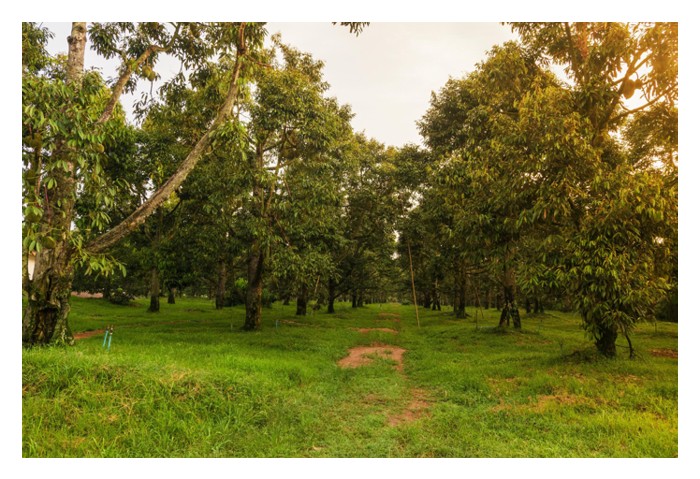
In the pursuit of premium fruits and consistent orchard performance, many durian farmers have turned to monoclonal planting — cultivating a single popular variety such as Musang King (D197), Black Thorn (D200), or Tupai King 226 across their entire farm. While this approach simplifies management and enhances brand consistency, it hides a serious biological drawback: reduced pollination and lower fruit yield.
Durian (Durio zibethinus) is an entomophilous, cross-pollinated crop, relying primarily on bats (especially Eonycteris spelaea), along with moths and bees, to transfer pollen between flowers. The challenge arises because most durian clones are self-incompatible, meaning a flower cannot fertilize itself with pollen from the same tree—or even another tree of the same clone. In simpler terms, a Musang King tree needs pollen from a different durian clone to set fruit successfully. When the entire orchard is genetically identical, pollen transfer becomes futile, and the number of successfully fertilized flowers drops drastically.
Studies conducted in Thailand and Malaysia have consistently shown that monoclonal orchards can experience up to 30–60% lower natural fruit set compared to mixed-clone orchards. In some farms where Musang King is planted exclusively, natural pollination rates are as low as 5–10% unless manual hand-pollination is performed. That means farmers must rely heavily on labor-intensive pollination methods, increasing operational costs and reducing scalability.
Beyond biology, monoclonal planting also limits flowering synchronization. Each durian clone tends to have slightly different flowering periods, even within the same region. By mixing clones—such as combining Musang King with D24, D160 (Tekka), or D101—farmers extend the pollination window and ensure overlapping bloom periods. This natural overlap enhances cross-pollination opportunities and ultimately improves fruit set and yield stability.
From an ecological standpoint, clone diversity also attracts a broader range of pollinators. Different clones may produce slightly different flower scents, nectar compositions, and blooming times, sustaining pollinator populations over a longer period. Healthier pollinator communities, in turn, lead to more reliable and consistent pollination services year after year.
Economically, a well-balanced durian orchard should not only aim for high-value varieties but also strategic clone diversity. Planting 70–80% of a primary clone (for market identity) and 20–30% of compatible pollinator clones can achieve both brand consistency and biological efficiency. Some commercial farms in Pahang and Johor have adopted this system, reporting up to 40% increases in fruit yield without additional fertilizer or labor input.
In conclusion, while monoclonal planting offers short-term convenience, it poses a long-term threat to yield potential and orchard resilience. Nature thrives on diversity—and so should durian orchards. A balanced mix of clones is not just good genetics; it’s good business. After all, every successful durian season begins not with fertilizer or pruning—but with a well-pollinated flower.
Source: Professional Platform
Note: For Reference Only