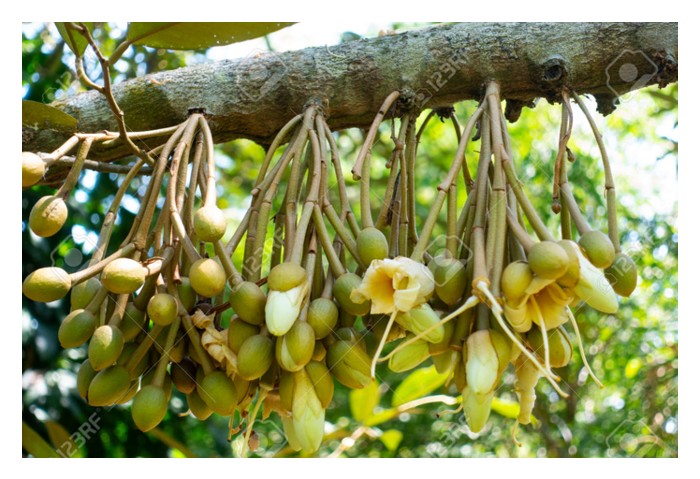
Solid scientific proof that always removing the first flowers of a durian tree gives a long-term benefit is rare to find. But there are a bunch of related observations, practices, and hypotheses from farmers and some agricultural-extension writings as shown below :
What people say they do, and why
Across various durian‐growing regions (Malaysia, Vietnam, etc.), farmers sometimes:
- Remove extra buds or flowers when there are multiple waves of flowering, keeping only the most promising or strongest wave.
- Discard weak, small, badly positioned flowers (for example, at branch tips or under dense canopy) so that tree resources (nutrients, water, photosynthates) are not wasted on fruit that likely won’t set well.
- Do “flower pruning” or selective flower bud removal to improve fruit set, improve fruit quality, and manage nutrient allocation.
So there is an agronomic/practical basis: the idea that too many early flowers (esp on young trees or when the tree isn’t strong) may burden the tree, reduce growth, or lead to a lot of fruit drop and wasted energy.
What the scientific studies don’t support (or have yet to demonstrate)
No study (so far) was found that directly tests “remove first‐flowering vs let them stay” in a rigorous experimental design (e.g. randomized trial, long‐term, multiple trees) to measure long-term benefits (bigger yield later, longer productive life, etc.).
Some gaps are:
- No quantified data on how removal of first flowers affects tree vegetative growth afterwards (trunk/branch growth, leaf area) versus letting fruits develop (or try to).
- Lack of measurements over several seasons to see if fruit quality / yield improves long term under flower removal vs no removal.
Related scientific evidence & biology that suggests it might help
Even though the specific experiment is missing, there are biological and “analogy” supports:
- Resource allocation trade-off
Plants have limited resources (nutrients, carbohydrates, water). Early fruiting costs energy. By reducing early fruit load, the tree can direct more to vegetative growth — more leaves, stronger branches, bigger root system. That often results in better capacity for future flowering/fructification.
- Flower & fruit drop
Durian trees tend to drop many flowers or very young fruit if conditions aren’t favorable (nutrients, moisture, pollination, weather). If a lot of weak flowers or fruit are allowed, much of those are “wasted” effort. Removing them early might reduce “waste”. Some farmer guidelines suggest removing deformed or weak flowers to increase fruitset rate.
- Flowering waves & synchrony
Multiple waves of flowering can complicate management. For example, when flowers bloom in different batches, fruit set, harvesting, disease/pest control etc can be more difficult. Some farmers remove excess flower waves so harvesting occurs more uniformly.
- Tree strength / age matters
Young trees may benefit more from skipping early fruit, because they need to build up structure (wood, roots, foliage) before producing heavily. If a young tree flowers too early and sets many fruit, that may stress it. This is common in many fruit trees, though for durian specifically the data is thin.
So, bottom line: Is there proof?
Not yet, at least not in published science (as of latest sources). The idea is plausible, and many farmers practice variations of flower removal, but we don’t have controlled studies showing “removing the first flowering always gives X % more yield or longer life” under different conditions.
Source: Professional Platform
Note: For Reference Only